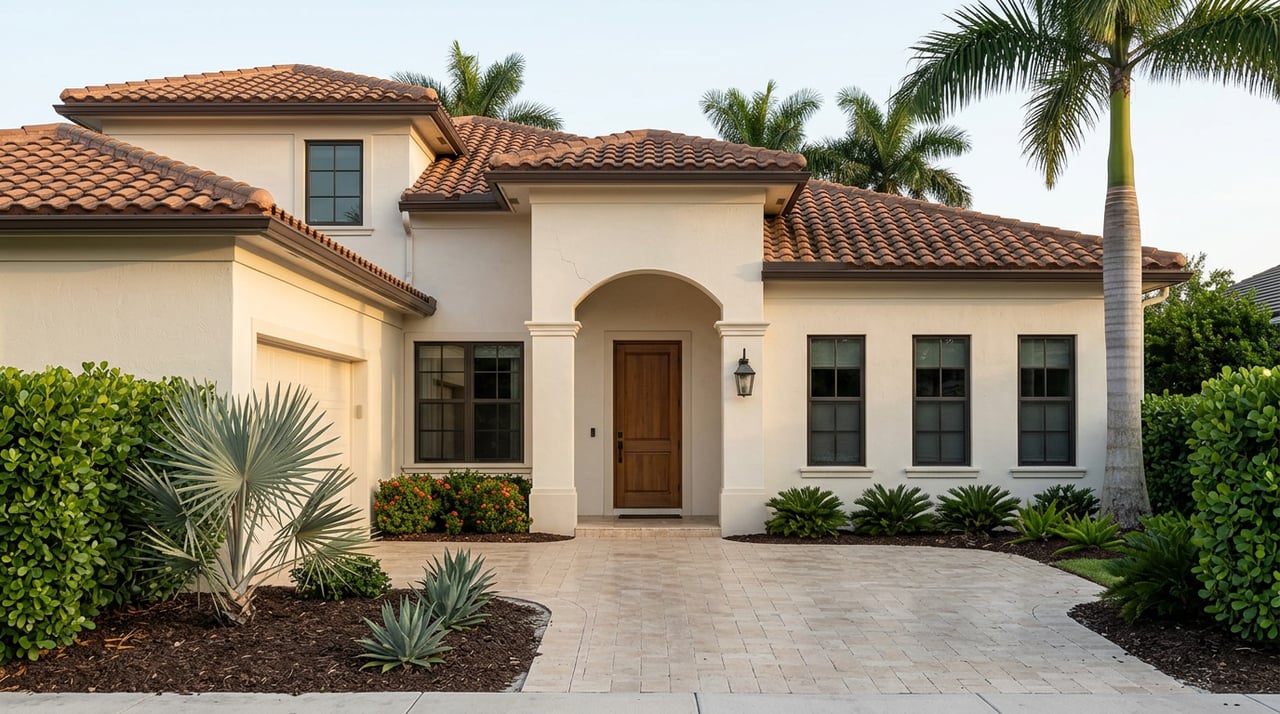
In Avenir, the HOA Fee Is Only Half the Bill
August 20, 2026
August 20, 2026
A buyer comparing two similar homes in Avenir's Regency enclave will find nearly identical HOA dues listed on both sheets, somewhere around $412 a month. What the sheets will not show is a second bill, filed separately with the county rather than the homeowners association, that can differ by thousands of dollars a year between those two houses even though they sit on the same street, carry the same builder finish package, and sold within a few weeks of each other.
That second bill is the Community Development District assessment, and in Avenir it does not move by enclave the way the HOA fee does. It moves by parcel, and in some cases by the width of the lot itself. Two houses that look identical from the street can carry meaningfully different annual costs, and neither the portal listing nor the community's own marketing pages will tell you which one you are buying until you ask for the parcel number.
Avenir's HOA dues are the number every listing leads with, and they vary sensibly by enclave and amenity tier. Apex by GL Homes runs close to $416 a month. Regency by Toll Brothers sits near $412. Avondale by DiVosta lands between $337 and $350. Solana Bay by Akel Homes is the lightest at roughly $258. Those figures track logically with what each enclave offers, from clubhouse access to landscaping tiers, and a buyer comparing them side by side is comparing something real.
The trouble is that this is the only fee most buyers see quoted in a headline number, and it is not the only recurring cost attached to owning here.
Avenir sits on 4,752 acres, and infrastructure at that scale, roads, stormwater systems, wetland mitigation, entry features, parks, and shared amenities, is financed through a Community Development District rather than folded entirely into the builder's price or the HOA's monthly dues. A CDD is a local special-purpose government created specifically to fund and manage that kind of community-wide backbone. The assessment it levies is billed as a non-ad valorem charge on the annual property tax bill, alongside the ad valorem taxes every Palm Beach County homeowner already pays.
A common assumption is that a CDD assessment simply covers road maintenance and stays roughly flat across a community. Avenir's own district budget for the 2025 and 2026 fiscal year shows a different picture. Annual parcel totals in that budget span from $3,403.14 on a 55-foot lot in Parcel A-20 to $8,841.14 on Parcels A-17 and A-19, a difference of more than $5,400 a year between properties inside the same master plan. A third parcel, A-16, ranges from $4,925.14 to $6,654.14 depending on the width of the individual lot. The district-wide operation and maintenance assessment alone totals nearly $6.9 million for the year, spread unevenly across thousands of individual parcels rather than divided evenly per household.
That unevenness is the part a buyer needs to sit with. Two houses in the same enclave, built by the same company, priced within a few thousand dollars of each other, can carry CDD obligations that differ by more than the HOA fee itself. The enclave-level HOA number a listing agent quotes is accurate. It is also incomplete.
The practical takeaway is not that CDD assessments are unusually high in Avenir. It is that the number that determines your real monthly carry is tied to the specific parcel, not the community average, and the only way to know it before closing is to ask for that parcel's line item from the district's own assessment roll rather than relying on a marketing page's summarized range. A buyer who budgets off the enclave HOA figure alone, then discovers the CDD line at the closing table, has budgeted off half the picture.
This is not unique to any one builder or enclave inside Avenir. It is a structural feature of how large master-planned communities finance themselves, and it means the smart move is the same regardless of which section you are considering: get the parcel-specific CDD assessment in writing before you write an offer, not after.
The reason this is worth untangling rather than dismissing is that the CDD money, unlike a typical HOA fee, is largely responsible for the infrastructure that makes Avenir function as a place rather than a collection of subdivisions. The clearest evidence of that arrived this year. Avenir's Town Center, a nearly 200,000 square foot retail and dining hub reachable by golf cart from most of the community's enclaves, opened its anchor Publix on May 21, 2026, according to the developer's own announcement. Walgreens followed in early summer, and the rest of the roughly nineteen storefronts, including H&H Bagels, Carmela Toast and Coffee Bar, Seppe Pizza Bar, Kevin James Salon, Venetian Nail Spa, and Velocity Community Credit Union, are phasing in through the summer and into fall 2026.
That kind of internal infrastructure, along with the roads, lakes, and preserve areas the CDD also funds, is part of what separates an Avenir home, priced anywhere from the high $700s to over $20 million, from a comparably priced home in a community without that backbone. It is also part of what supports the far end of Avenir's own price range. Panther National, the private golf enclave inside the larger community, centers on a Jack Nicklaus and Justin Thomas collaboration that Golf Digest ranked 12th among its Best Courses in Florida, with estates there priced from roughly $7 million to $22 million. A single community that spans high $700s townhomes to eight-figure custom estates is only coherent because the shared infrastructure, financed in large part through that CDD structure, holds the whole thing together.
Just to the west, Westlake takes the opposite approach, and the contrast is instructive rather than a verdict on either community. Built out by Minto on roughly 3,800 acres, Westlake markets itself specifically on carrying no CDD fees at all, with pricing from the mid-$300s to just over $1.1 million and its own operational town center already in place. The two communities genuinely overlap only in a narrow band, roughly $825,000 to $1.1 million, where an entry-level Avenir home and a top-tier Westlake home sit close in price.
Inside that overlap, the choice is not about square footage or finish level so much as it is about which cost structure you would rather carry. Avenir's buyer is paying for a Panther National address, multi-builder flexibility, and an ecosystem still expanding through 2026. Westlake's buyer is trading some of that scale and prestige for a flatter, more predictable monthly number with no separate district assessment to track down. Neither is the better financial decision in the abstract. They are different bets on what you want your carrying cost to be buying.
If you are comparing homes inside Avenir itself, the HOA figure quoted in the listing is a reasonable starting point but not a stopping point. Ask your agent or the builder's sales office for the CDD assessment tied to the exact parcel, not the enclave average, and confirm whether that assessment is fixed for the life of the bond or scheduled to change as the district retires debt or adds phases. If you are weighing Avenir against Westlake or another CDD-free community, run both all-in numbers, HOA plus CDD plus property tax, side by side rather than comparing sticker prices alone.
The homes that look identical on paper rarely carry identical bills. The difference is filed with the tax collector, not the homeowners association, and it is worth finding before the number finds you.
Frequently Asked Questions
Is the CDD assessment the same every year, or does it change? CDD assessments are set annually by the district's board as part of its budget process, and the debt-service portion typically declines over time as bonds are paid down, while the operation and maintenance portion can shift with the district's costs.
Does the CDD fee replace the HOA fee, or do I pay both? Both. The HOA fee covers community association services and amenities, while the CDD assessment is a separate, non-ad valorem charge that appears on your county property tax bill.
Can I find my specific parcel's CDD amount before I buy? Yes. The district publishes its budget with parcel-level assessment figures each fiscal year, and your agent or closing attorney can pull the exact number for a specific address before you make an offer.
Buyers who ask the right question about a home's true carrying cost tend to be the ones who move quickly and confidently when the right property comes along. If you are comparing homes in Palm Beach Gardens, Avenir included, and want the full picture before you write an offer, reach out to the Hasozbek-Garcia Team. Get access to our private listings.
Stay up to date on the latest real estate trends.
Bringing together a team with the passion, dedication, and resources to help our clients reach their buying and selling goals. With you every step of the way. Contact The Hasozbek-Garcia Team today for a free consultation for buying, selling, renting or investing in Florida.
Get in Touch With Our Team to Learn More
THE HASOZBEK-GARCIA TEAM
125 WORTH AVE STE 221 PALM BEACH FL 33480