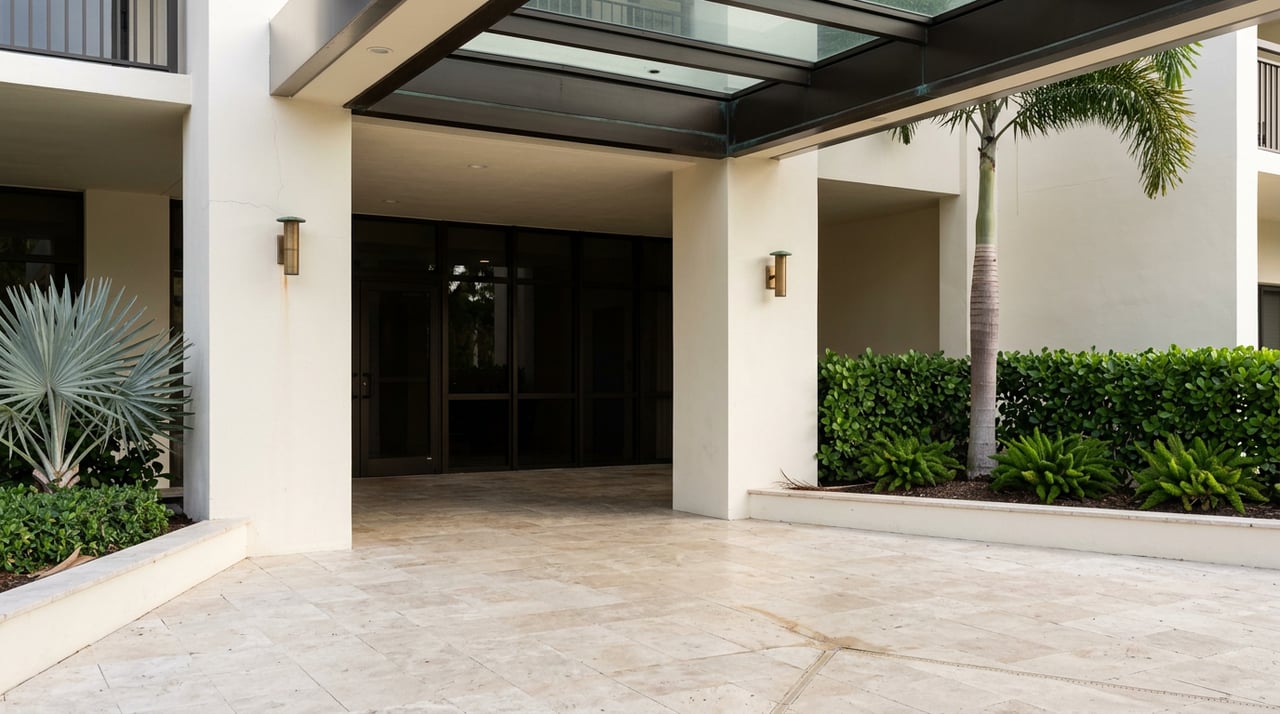
West Palm Beach Condo SIRS and Assessment Risks
August 13, 2026
August 13, 2026
Picture two condos on the same stretch of South Flagler Drive, priced within a few dollars of each other per square foot, both facing the Intracoastal. One closed last month with a routine transaction. The other comes with a board resolution buyers won't find on any listing sheet: a special assessment vote scheduled for the fall. Same water. Same skyline. Very different bill.
That gap has nothing to do with staging or square footage. It has to do with a filing cabinet most buyers never ask to see.
Palm Beach County's condo and townhouse market recorded 1,060 existing sales in April 2026, up 6.21 percent year over year, with a median sale price of $342,000 and active inventory sitting at 6,904 units, which works out to roughly 8.2 months of supply. On its face, that reads like a buyer's market. Sellers outnumber buyers, prices soften, patient shoppers win.
But months of supply is a blended number, and blending is exactly what hides the story here. Some of that inventory sits in buildings with nothing to worry about. Some of it sits in buildings that are, as of this year, legally required to have finished a structural review they may not have finished. The county isn't oversupplied with condos so much as it's sorting them into two categories buyers haven't historically needed to think about: buildings that cleared a 2025 deadline, and buildings that didn't.
The mechanism is Florida's post-Surfside reserve law. Under Florida Statute 718.112, condominium buildings three stories or taller must complete a Structural Integrity Reserve Study, a SIRS, at least once every 10 years, and for existing owner-controlled associations that deadline was December 31, 2025. That date is already more than seven months behind us. A narrow exception lets a building push its SIRS to line up with a milestone inspection due on or before December 31, 2026, but the statute is explicit that it cannot happen later than that. The window many boards used to buy themselves breathing room closes at the end of this year.
The reason this matters for buyers, not just boards, is what the same statute does to the vote. Once a building's SIRS is complete, owners can no longer vote to waive or underfund the reserves it identifies. The disclosure language associations are required to print isn't subtle. It states plainly that skipping those reserves "may result in unit owner liability for payment of unanticipated special assessments regarding those items." For decades, Florida boards kept dues low by voting that language away. As of the 2025 and 2026 budget cycles, that option is gone for the structural categories, which is precisely why assessments are showing up now instead of being quietly deferred again.
Geography sharpens the timeline further. Buildings within three miles of the coast face their first milestone structural inspection at 25 years of age rather than 30, per Palm Beach County's Building Division. Nearly every Intracoastal and oceanfront tower in West Palm Beach falls inside that three-mile line, which means the accelerated clock applies to most of the inventory a downtown condo buyer will actually tour.
Palm Beach County has roughly 3,200 condominium associations, and a large share of that stock was built during the 1980s and 1990s boom, putting many buildings squarely in the 30-to-45-year range where SIRS and milestone requirements now overlap, according to engineering firms tracking the local queue. Not every one of those buildings is in trouble. Plenty have funded reserves responsibly for years and will absorb the new rules without drama. But the ones that didn't are producing the numbers making headlines across South Florida in recent years.
None of the examples below are in West Palm Beach, and it would be misleading to imply otherwise, but they show what the same statute has already done elsewhere in the region. At Palm Bay Yacht Club in Miami, a 235-unit, 27-story building, the total assessment reached $46 million, highlighting the scale of the assessment burden. At Cricket Club in North Miami, a 1975 bayfront building, owners faced roughly $134,000 per unit. At Mediterranean Village in Aventura, assessments were reported as high as $400,000 per unit. These are outliers, not averages, but they're the outcome the law was written to catch before it reaches the scale of Surfside, and they explain why a lender now treats a building's SIRS file as seriously as a buyer's credit file.
That lender scrutiny has its own number attached. Fannie Mae's list of condo projects ineligible for conventional financing grew from a few hundred buildings before 2021 to roughly 5,000 as of 2025, and 696 of those buildings sit in Miami-Dade, Broward, and Palm Beach counties combined. A unit can look perfectly financeable in every other respect and still fall through at underwriting because the building itself, not the buyer, doesn't qualify.
This is the other half of the county's inventory math, and it's why new-construction towers along the same corridor aren't discounting to match older stock. South Flagler House, a two-tower waterfront project at 1355 South Flagler Drive developed by Related Ross with architecture by Robert A.M. Stern Architects, offers 108 residences and has already secured its major construction financing. Forté on Flagler, another newer waterfront project in the same downtown corridor, sits in the same category: buildings designed after the reform, not buildings adjusting to it.
Buyers comparing a pre-1995 tower to one of these newer projects aren't just weighing finishes and amenities. They're weighing a newer building's lower near-term structural uncertainty against an older building that may or may not have finished the paperwork the state now requires, while recognizing that the newer building's long-term budget remains unproven. That difference shows up in price per square foot, and it's a rational one.
| Pre-1995 tower | Post-2020 construction | |
|---|---|---|
| SIRS deadline | Should already be filed, or is currently past due | Not yet triggered by age |
| Reserve waivers | No longer legal for structural items under current budgets | Built into the initial budget |
| Special assessment risk | Depends entirely on that building's funding history | Low near-term, budget still unproven long-term |
| Financing | Confirm Fannie Mae project eligibility before writing an offer | Typically straightforward conventional financing |
| Price per square foot | Often lower on paper | Carries a premium tied to reduced structural uncertainty |
Neither column is automatically the better buy. A well-funded older building with a clean SIRS on file can be a stronger position than a new tower with an unproven budget. The point isn't old versus new. It's that the price alone no longer tells you which one you're getting.
Before an offer goes in on any West Palm Beach condo built before roughly 2000, ask the association for four documents:
None of these require a legal background to read. They require asking for them before the offer, not after.
Is a milestone inspection the same as a SIRS? No. A milestone inspection is a structural safety check performed by a licensed engineer or architect. A SIRS is a financial planning document that uses a visual inspection to set the reserve funding schedule. Buildings often coordinate the two, but they answer different questions: one asks if the building is safe today, the other asks if the association is saving enough for tomorrow.
Does a completed SIRS mean a building is safe from special assessments? Not entirely, but it substantially lowers the risk of a surprise. A completed study with reserves funded at recommended levels means the association has already priced in future repairs. A missing or outdated study means those costs, whatever they turn out to be, still have to land somewhere.
Why would anyone pay more for new construction if an older building is cheaper? Because the lower price on the older unit doesn't include what happens if the reserve study reveals a gap. A buyer who understands both numbers isn't choosing between cheap and expensive. They're choosing between a known cost and an unknown one.
If you're comparing waterfront buildings along Flagler Drive or anywhere else in West Palm Beach and want a second set of eyes on a reserve study before you write an offer, The Hasozbek-Garcia Team reads these documents for a living. Get Access to Our Private Listings and we'll walk the numbers with you before you fall for the view.
This article is general information, not legal, tax or financial advice. Consult a qualified professional about your situation.
Stay up to date on the latest real estate trends.

Bringing together a team with the passion, dedication, and resources to help our clients reach their buying and selling goals. With you every step of the way. Contact The Hasozbek-Garcia Team today for a free consultation for buying, selling, renting or investing in Florida.
Get in Touch With Our Team to Learn More
THE HASOZBEK-GARCIA TEAM
125 WORTH AVE STE 221 PALM BEACH FL 33480