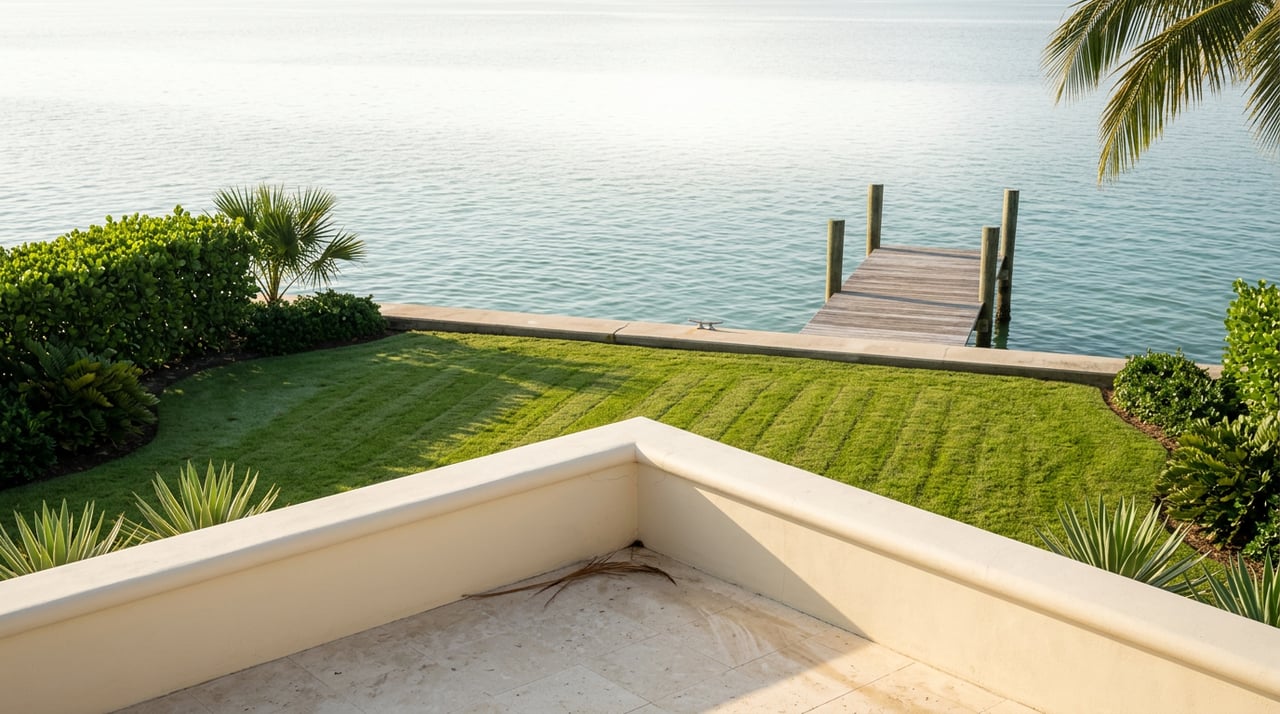
Jupiter Waterfront Seawall Permits: Two Numbers Matter
August 27, 2026
August 27, 2026
Which seawall costs more to bring into compliance: the one with a hairline crack running along the cap, or the one that was repainted last spring and looks perfect from the dock? The honest answer is that you cannot tell by looking. The variable that decides how complicated a Jupiter seawall repair becomes has almost nothing to do with what the wall looks like. It has to do with two numbers that never appear in a listing photo, and most buyers only discover them after they are already under contract.
Jupiter, like every municipality that participates in the National Flood Insurance Program, applies what is known as the substantial improvement rule. The town's own flood mitigation guidance lays it out plainly: any repair or improvement to a structure in a flood hazard zone becomes a "substantial improvement" once the cost of the work equals or exceeds 50 percent of that structure's market value.
Here is the part that catches people off guard. That 50 percent threshold is measured against the market value of the structure, not against the cost of the seawall itself. Two homes on the same stretch of water can carry seawalls in identical condition, quoted for identical repair work, and land on opposite sides of that line. An older, more modestly assessed riverfront home can tip into full-compliance territory at a repair cost that would barely register for the estate two docks down. The seawall does not know the difference. The paperwork does.
This is why asking a seller "how is the seawall" is the wrong question. The better question is what the permit history says about prior repairs.
The second number is geographic, and it is specific to Jupiter in a way that does not apply to most other Palm Beach County waterfront.
The Loxahatchee River carries a federal designation that very few Florida waterways share. The National Wild and Scenic Rivers System says it was named a National Wild and Scenic River on May 17, 1985, and the protected segment runs a defined 7.6 miles from Riverbend Park downstream to Jonathan Dickinson State Park. That designation is not decorative. Marine contractors who work the river regularly, including JKT Marine Construction, note that seawall and shoreline work along the Loxahatchee requires sign-off from the Army Corps of Engineers and the Florida Department of Environmental Protection in addition to the standard county and South Florida Water Management District review that applies everywhere else.
Here is how that plays out for two otherwise comparable projects.
| Canal or Intracoastal-front repair | Loxahatchee River segment repair | |
|---|---|---|
| SFWMD or county environmental review | Typically required | Typically required |
| Realistic added review time | Weeks | Additional weeks to months, agency dependent |
Neither column tells you anything about whether the wall itself needs work. Both describe the process a buyer or seller has to walk through once it does.
None of this shows up on a walkthrough. A seawall can look structurally sound and still carry an incomplete permit history, and the reverse is just as common: a wall that looks tired can be fully permitted and compliant, with the cosmetic wear simply cosmetic. The only way to know which situation you are in is to pull the permit record before the inspection period closes, not after.
This matters for financing and insurance too, even in a market that is otherwise easing. Citizens Property Insurance Corporation filed for an average 8.8 percent multiperil rate decrease in 2026, and its statewide policy count had fallen to roughly 336,000 as of early March 2026, down from a peak of 1.41 million in October 2023, as more coastal risk moves back to private carriers. That broader easing does not remove the underwriting scrutiny that coastal carriers apply to individual properties. Carriers writing coastal policies still apply stricter underwriting and higher deductibles for named storm risk in higher-exposure zip codes, and a seawall with a thin or unclear permit trail is the kind of documentation gap that slows an underwriting file down regardless of what the statewide averages are doing.
For a seller, that means a clean, complete shoreline permit record is worth stating plainly in the listing rather than assuming a buyer will take the wall on faith. For a buyer, it means the seawall inspection you would order anyway is only half the job. The other half is a records request.
A few specific requests, made early, save weeks later:
None of this replaces a physical inspection. It sits alongside one, and for waterfront property on this particular river, it is arguably the more revealing document of the two.
If the seawall looks fine, do I still need the permit history? Yes. Visual condition and permit status are two separate questions. A wall can look sound and still carry gaps in its compliance record that will surface the moment any future work is proposed.
Is 50 percent of the seawall's cost or the house's value the trigger? The house. The National Flood Insurance Program's substantial improvement standard measures the cost of the work against the market value of the structure itself, which is why identical repair estimates can land two neighboring homes in very different regulatory positions.
Waterfront ownership in Jupiter rewards owners who treat the shoreline as part of the property record, not just part of the view. If you are weighing a purchase or a sale on the Loxahatchee, the Intracoastal, or the inlet, The Hasozbek-Garcia Team can walk the permit history alongside the property itself before you write or accept an offer.
This article is general information, not legal, tax or financial advice. Consult a qualified professional about your situation.
Stay up to date on the latest real estate trends.
Bringing together a team with the passion, dedication, and resources to help our clients reach their buying and selling goals. With you every step of the way. Contact The Hasozbek-Garcia Team today for a free consultation for buying, selling, renting or investing in Florida.
Get in Touch With Our Team to Learn More
THE HASOZBEK-GARCIA TEAM
125 WORTH AVE STE 221 PALM BEACH FL 33480