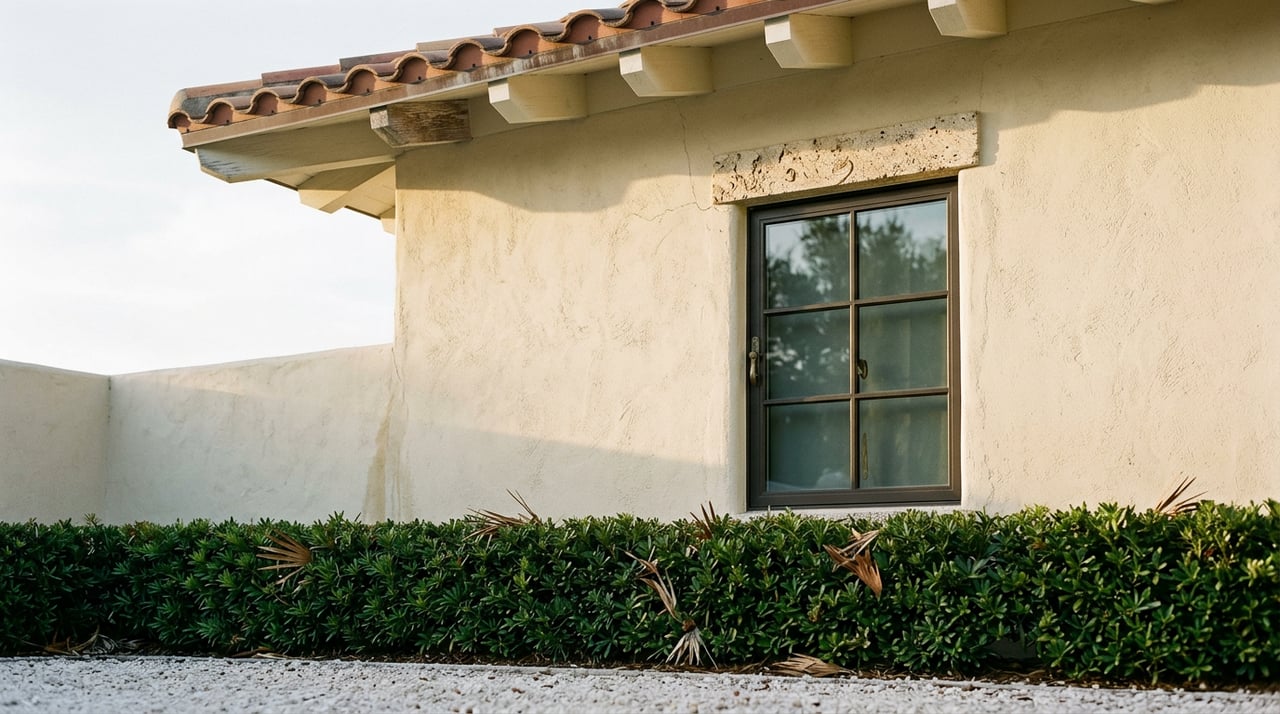
On Palm Beach Island, the Renovation Clock Starts at Closing, Not at Contract
September 10, 2026
September 10, 2026
In May 2026, the Palm Beach Town Council took up a modest, century-old bungalow on Chilean Avenue. It was not a waterfront trophy or a Mizner original. It was the kind of house a new owner might reasonably plan to update within a year of closing. The council's vote to designate it a historic landmark came back tied 2 to 2, and Mayor Danielle Moore broke the deadlock in favor of protection. The owner, a corporation that had held the property for roughly three decades, had argued through counsel that the house didn't meet the ordinance's criteria for architectural or historical significance. The council disagreed. Under the Town's landmarks ordinance, an owner's objection does not stop a designation from going through.
That case is worth knowing before you write an offer on Palm Beach Island, and not because your future purchase is likely to become a landmark fight. It's worth knowing because it demonstrates something buyers routinely underestimate: the review process that shapes what you can build, and when, does not scale with the size or fame of the property. It scales with a set of rules that apply the same way to a $30 million oceanfront estate and a modest house three blocks off Worth Avenue.
At any given time, roughly 80 new or substantial single-family projects are moving through permitting on the island. Fewer than half of them deliver on the timeline the owner started with. Ask why, and the answer almost never traces back to the general contractor. It traces back to the Town's Architectural Commission, known locally as ARCOM, which reviews the exterior of every new build and substantial alteration visible from a public right of way before the Building Division will even look at a permit application.
ARCOM is a panel of Town-appointed residents, at least two of them licensed architects, tasked with deciding whether a project's massing, materials, and detailing fit its surroundings. For properties inside a historic district or carrying landmark status, a second body, the Landmarks Preservation Commission, adds its own review under Chapter 54 of the Town Code. The LPC meets monthly, on the third Wednesday, and its scope reaches further than most buyers expect: demolition of a contributing structure is rarely routine, and denial is common for buildings constructed before 1965 inside a historic overlay, even without a formal landmark designation already in place.
A real ARCOM agenda from earlier this year makes the point better than any summary could. Alongside a full renovation at 1066 North Ocean Boulevard and a new single-family build at 217 Indies Drive, the same meeting cycle included a storefront at 259 Worth Avenue seeking approval for new signage, an entry door, and awnings. That application still needed a full hearing, and it was deferred to a later meeting. On this island, an awning gets the same procedural seriousness as a roofline.
The math is specific enough to plan around, which may be exactly why so few buyers do.
| Stage | Typical duration |
|---|---|
| Pre-application and scheme development | 4–8 weeks |
| ARCOM preliminary review | Runs on the meeting calendar; each remand adds 4–6 weeks |
| Landmarks review (if the parcel is landmarked or in a historic district) | Monthly, third Wednesday |
| Final ARCOM approval | Requires elevations at 1/4 scale or tighter, material samples, window details |
| Building Division permit review | 12–20 weeks, depending on backlog |
| ARCOM add-on to the permit track | Roughly 6–12 weeks, assuming no remand |
| CCCL review (oceanfront parcels only) | Runs in series with ARCOM, not alongside it, adding 3–5 months |
A 6,000 to 10,000 square foot custom residence typically takes 16 to 22 months from excavation to certificate of occupancy, assuming no substantial change orders. That figure already accounts for a project that clears review cleanly. The projects that fall outside their original schedule almost always share one pattern: the applicant presented a scheme to ARCOM before it was fully resolved, the commission remanded it, and the owner lost a month or more to the next cycle.
Additions to a contributing structure must be subordinate in scale and differentiated in detail. You cannot simply match the original if the original is historically significant.
That standard, drawn from the Town's historic preservation guidance, is not a matter of taste. It's a specific design constraint that shows up in the review of exterior materials down to stucco finish, roof tile profile, and window muntin width, a level of scrutiny most builders arriving from outside the Town have never encountered.
Not every parcel on the island carries the same review weight, and knowing which pocket you're buying into changes what you should model before you close.
More than 328 landmark properties, sites, and vistas are currently protected under the Town's Historic Preservation Ordinance, first adopted in 1979. That protection is not limited to architectural landmarks in the obvious sense. As the Chilean Avenue vote showed earlier this year, a house can be pulled into that count without its owner's consent, based on criteria the Town Council, not the buyer, gets to weigh.
Renovation work inside a historic overlay tends to run 15 to 30 percent higher than comparable work on a non-historic property, with timeline extensions of two to six months showing up regularly. On a $5 million interior-heavy update, that percentage is real money, and it lands on the buyer's side of the ledger, not the seller's.
This is the piece that changes how a Palm Beach purchase should be underwritten. Most buyers can close before ARCOM approves a renovation plan, and most do. But the review clock starts at closing, not at contract. Every week spent in pre-application design work, every ARCOM cycle, every LPC hearing if one applies, happens on the new owner's calendar and at the new owner's carry cost. A buyer who assumes the seller's estimate of "six months to permit" without checking whether the parcel sits inside a historic district, or whether it's an oceanfront lot layering on CCCL review, is modeling someone else's timeline, not their own.
Can I close on a Palm Beach estate before ARCOM approves my renovation plans? Yes, and most buyers do. The tradeoff is that the review clock starts at closing rather than at contract, and the carry costs during design and review become the buyer's expense.
Does landmark status hurt resale value? It depends on the buyer. Some prize the guarantee that a neighbor cannot demolish an adjacent property for a mismatched design. Others view the material and modification restrictions as a real constraint on future flexibility. Either way, it's a fact to price in, not a surprise to discover after closing.
Is the timeline different if I buy off-market? The overlay rules are identical whether a sale is public or private. What off-market access can offer is time, specifically the chance to have a quiet conversation with the Town's planning staff before you own the parcel, which a public listing timeline typically doesn't allow.
Palm Beach's review process is not a secret, but it is rarely explained to a buyer before the offer is signed. If you're evaluating a property on the island and want a clear read on what its address, its district, and its history actually mean for your timeline before you commit, the Hasozbek-Garcia Team works through exactly this kind of due diligence with clients as a matter of course. Get Access to Our Private Listings to see what's available before it's public, and to start the conversation with the right questions already answered.
Stay up to date on the latest real estate trends.
Bringing together a team with the passion, dedication, and resources to help our clients reach their buying and selling goals. With you every step of the way. Contact The Hasozbek-Garcia Team today for a free consultation for buying, selling, renting or investing in Florida.
Get in Touch With Our Team to Learn More
THE HASOZBEK-GARCIA TEAM
125 WORTH AVE STE 221 PALM BEACH FL 33480